
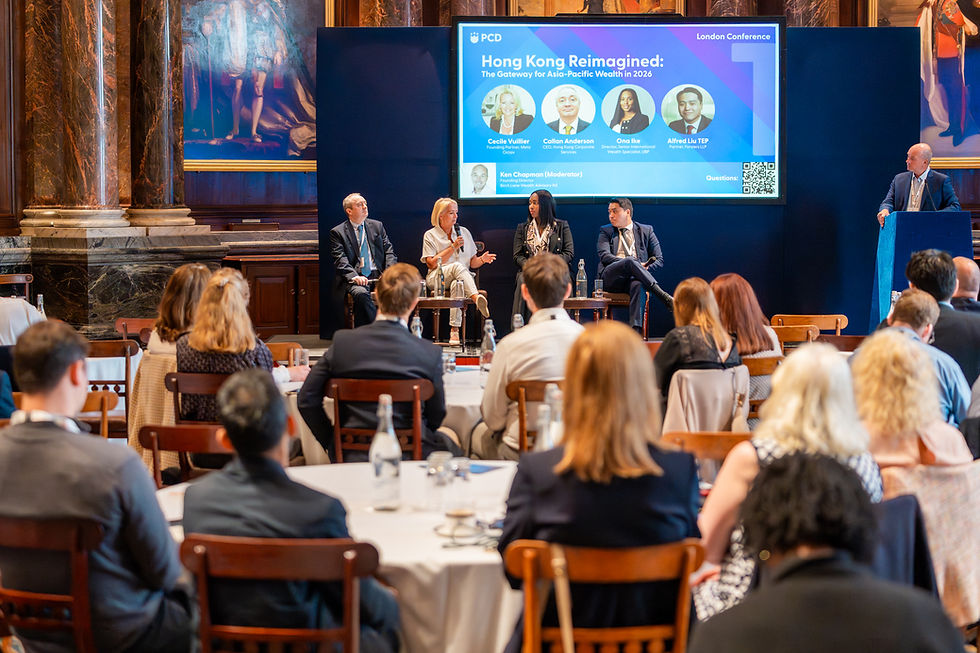
For anyone who has been following Western media coverage of Hong Kong, the narrative has been one of decline — protests, political change, an exodus of talent. But for the panellists gathered at the PCD London Conference 2026, the story looks entirely different from the inside. Hong Kong, they advocated, has not merely survived the turbulence of recent years. It has adapted, evolved, and in several respects, become more attractive than ever for high-net-worth families and international structuring. A sign of its enduring resilience during decades of being a robust and tried and tested international finance centre.
The statistics set the scene. Hong Kong is currently the world's number one IPO market — twenty times the volume of London and approximately five times that of New York. The middle class in mainland China, which now stands at around 400 million people, is projected to reach 800 million within a decade. That represents an enormous and rapidly growing pool of wealth seeking sophisticated financial services, and Hong Kong remains the essential conduit. Approximately 80 percent of all capital flowing in and out of China passes through Hong Kong, a function of its unique position as the only place where China's currency can be freely traded offshore.
Many observers speak of Hong Kong as if it has somehow "become Chinese" in recent years. In reality, Hong Kong has always been part of China; what makes it unique is the continued application of the "One Country, Two Systems" principle. While it is unquestionably Chinese, it retains its own legal system based on English common law, its own currency, independent tax regime, financial regulators, immigration system and commercial framework. In many respects, the relationship can be compared to that between Monaco and France: closely connected, yet operating under a distinct legal and economic framework. This unique position continues to make Hong Kong attractive not only to local families and mainland Chinese entrepreneurs, but also to international business owners and wealthy families from across Europe, the Middle East, Africa and the Americas who use the jurisdiction as a gateway to Asia and as a platform for global structuring. Its network of 57 Comprehensive Double Taxation Agreements (CDTAs) further enhances its appeal, facilitating cross-border investment and reducing fiscal friction for internationally mobile families and businesses.

Callan Anderson, CEO of HKCS Group and a Hong Kong resident for 26 years, offered a brisk corrective to common misconceptions. Hong Kong continues to drive on the left. Its power sockets are British. English-based common law still governs its courts, with senior judges still drawn from the UK, Canada, Australia and New Zealand. The government remains notably hands-off — it is the second-freest economy in the world after Singapore — and there are no currency controls. Press a button at HSBC and money leaves the same day, no questions asked.
Those structural features have been reinforced, not eroded, since the 1997 handover. Hong Kong has introduced redomiciliation legislation, allowing overseas companies to relocate their registered headquarters there — a move that has already prompted major insurers including AXA and Manulife International to shift. A new closed-form company register means that only licensed professionals can access beneficial ownership information, providing meaningful confidentiality in an era when transparency requirements are tightening across most rival jurisdictions.

Alfred Liu, Partner at Forsters LLP in London, highlighted a recent client example illustrating Hong Kong’s competitiveness as a jurisdiction for the internationally mobile. The client, an unmarried German entrepreneur who had long been resident in Hong Kong, relocated to Italy during the COVID pandemic, attracted in part by its flat tax regime. However, with the bulk of his wealth held in Europe, he became concerned about the potential application of forced heirship rules under the EU Succession Regulation whether via Italy (as his habitual residence) or Germany (by nationality). Given his wish to avoid his only child receiving a substantial inheritance outright, these succession law constraints were deeply unattractive. As a result, re-establishing habitual residence in Hong Kong has emerged as a key strategic priority in his succession planning. In this case, the decisive factor to his residence is not tax as it so commonly can be, but Hong Kong’s robust common law framework, which offers flexibility in full testamentary freedom and no forced heirship. The relocation pathways are also increasingly accessible. The New Capital Investment Entrant Scheme requires an investment of just HKD 30 million — approximately USD 3.8 million — and grants permanent residency within seven years. For those with a company in Hong Kong, work visas can typically be obtained within eight weeks. Ona Ike, Senior International Wealth Specialist at Union Bancaire Privée (UK) Limited, noted that there are also routes for highly skilled professionals and entrepreneurs that attract less attention but are equally viable.
The panel were candid about friction. Opening a bank account takes up to three months, and compliance standards at major international banks headquartered in Hong Kong are stringent. But once established, the freedom of movement for capital is unmatched among comparable jurisdictions.
One of the more striking observations came from the trend of African ultra-high-net-worth families now orienting toward Hong Kong rather than traditional Western financial centres. Where they once went to London or New York to access capital markets and private banking services, a growing number are establishing structures and sending children to school via Hong Kong — a signal of the city's broadening gravitational pull.

Cécile Civiale Vuillier, co-founder of META OCTAV in Geneva and Hong Kong, reinforced the point from a trustee's perspective. Hong Kong is not merely business-friendly in principle — it is refreshingly focused on solutions and client needs rather than defaulting to a compliance-first mindset that can stifle creativity in European jurisdictions.
For professionals advising internationally mobile clients, the message from Hong Kong is consistent: the substance is still there, the infrastructure is still world-class, and the legal system remains one of the most reliable in Asia. The perception gap between the headlines and the reality, several panellists suggested, may itself be one of the most significant opportunities of the moment.


