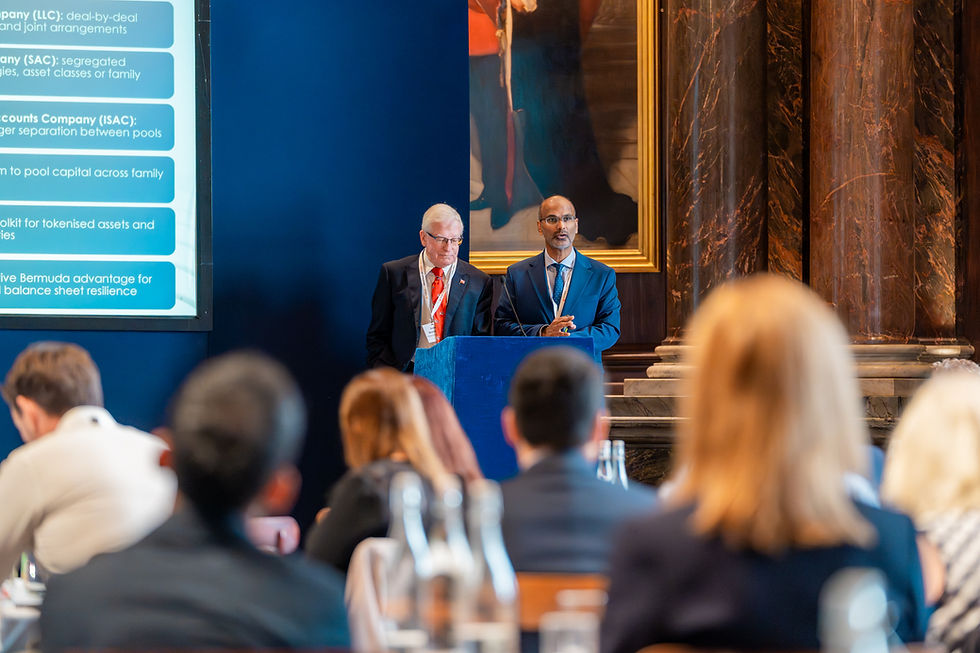
Bermuda is not the answer for every family office. James Watlington, Founder and Chairman of Alexanders Bermuda, and his colleague Belaid Jheengoor, Director at Alexanders Group, were admirably direct about this at the PCD London Conference 2026. Their session was not a sales pitch. It was a careful, structured examination of where Bermuda genuinely adds value within a modern multi-jurisdictional family office architecture — and where it does not.
The starting point, James Watlington argued, is context. Family offices are navigating an increasingly complex agenda: geopolitical uncertainty, generational transition, tightening regulation, digital asset exposure, and the growing expectation of institutional-grade governance. Against this backdrop, the jurisdictions that matter are not necessarily the most exotic or the most aggressive on tax. They are the ones that offer genuine stability, tested legal infrastructure, and substance — advisors and courts that have seen difficult trust disputes, resolved them, and refined the law in response.
Bermuda's key differentiator is experience. Trusts law there is not simply legislation on paper; it has been tested in courts, clarified through litigation, and continuously updated. Section 47 of the Trustees Act is a practical illustration: it empowers the Bermuda Court to authorise trustees to enter into transactions not otherwise permitted under the trust deed, without requiring the consent of adult beneficiaries. This kind of statutory flexibility matters enormously for older structures that were built for a more predictable world and now need updating.
Belaid Jheengoor explained where Bermuda most naturally fits within a broader family architecture — not as the sole jurisdiction for a family office, but as a platform for specific purposes: a branch or extension of an existing structure; a plan B for business continuity; a hub for families with significant east coast US exposure, for whom Bermuda's proximity and favourable time zone are practical advantages; and a compliance and regulatory platform for families operating across multiple jurisdictions who need a stable anchor. The private trust company model — licencing exemption available — combined with the exempt company holding vehicle and the flexibility of incorporated segregated accounts companies offers a toolkit that is coherent, legally certain, and administratively efficient.
On the question of digital assets, Bermuda has carved out a distinctive niche. The Bermuda Monetary Authority has granted fewer than 50 digital asset business licences, a deliberate policy choice reflecting a quality-over-volume approach. The BMA's regulatory framework is increasingly cited as a gold standard for responsible digital finance, and Bermuda is now proposing to extend its banking framework to accommodate both representative banks and digital asset banks.
Bermuda's other widely overlooked offering is captive insurance. This is where the concept was invented, and it remains Bermuda's most singular advantage for sophisticated family offices. For families managing enterprise-scale risk — coverage gaps, balance sheet resilience, retained risk strategies — Bermuda's captive insurance infrastructure is unmatched anywhere in the world.
On privacy, the presenters were careful to distinguish between secrecy and structured confidentiality. Bermuda has no public trust register. Personal information is governed under the Personal Information Protection Act, overseen by a privacy commissioner. Beneficial ownership information is held in a secured, restricted-access electronic database, accessible only through proper legal gateways. Anonymisation orders are available in trust litigation. Bermuda is transparent where required by international standards — it complies with Common Reporting Standards and Country-by-Country Reporting — but manages that transparency through proper process rather than public exposure.
For families seeking a deeper connection to the jurisdiction, the Economic Investment Residential Certificate offers residency for a USD 2.5 million investment. The family office work permit, designed to bring key personnel into the jurisdiction quickly, is typically processed in around ten working days.
Alexanders is expanding beyond Bermuda, with corporate and trust services now in Mauritius and a London office focused on due diligence and source of funds verification — increasingly important as institutions everywhere tighten their onboarding requirements.
The picture that emerged is of a jurisdiction that has invested carefully in its credibility over decades, and that now offers a stable, well-regulated, and remarkably flexible foundation for family office structures that need durability as much as efficiency.